In this first interview, we go behind the scenes to explore how that idea developed into a cooperative game of floating Worlds, stacking Essence, and desperate last-minute victories.
Where did the original idea for OTH come from?
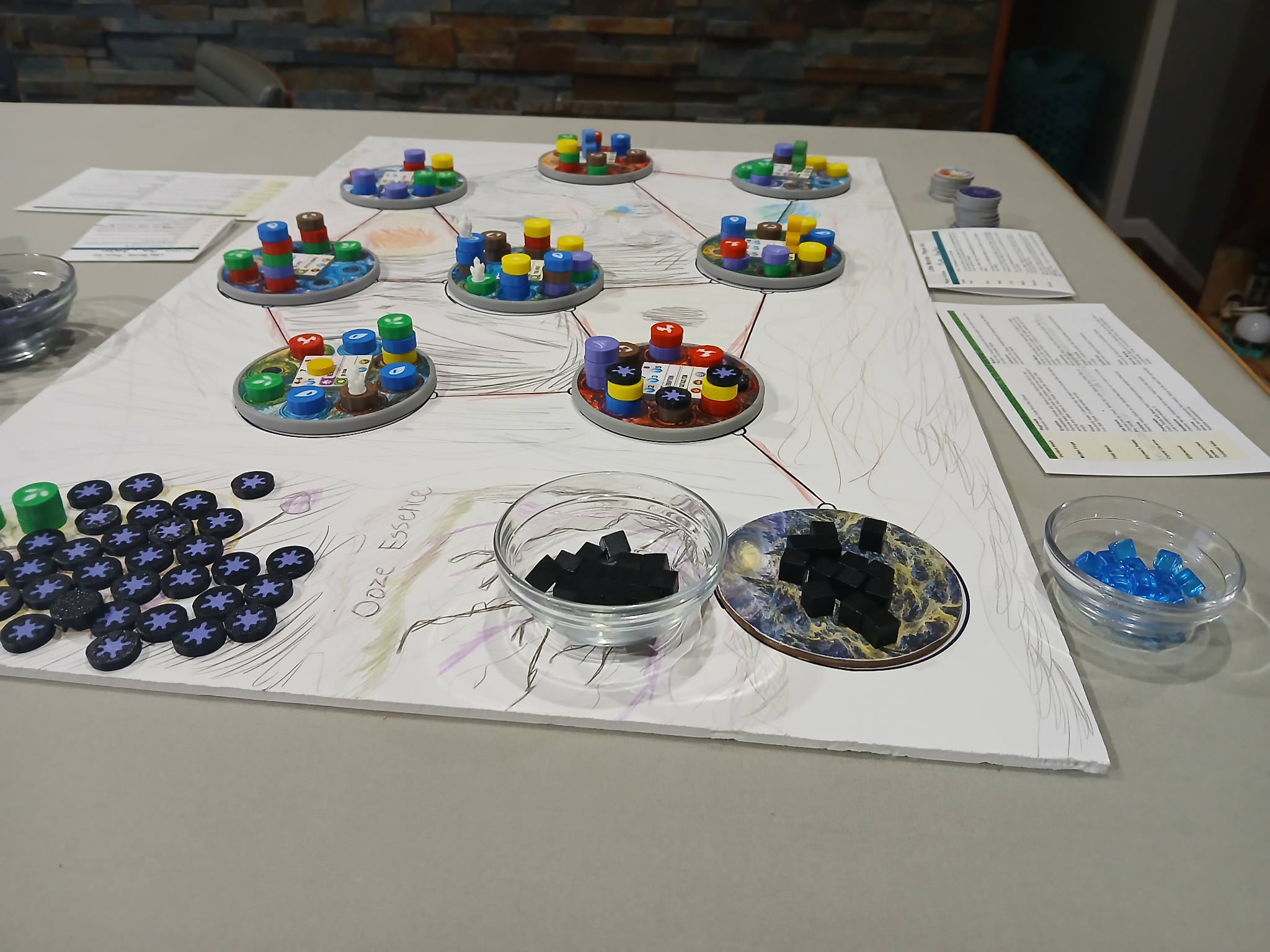
I’ve wanted to make a game where players develop their own small Worlds in a universe filled with other little Worlds. That’s actually where the game’s original development name, Little Worlds, came from.
Early on, I took some inspiration from the video game Reus. I liked the idea of developing a World by combining different ingredients, and I started brainstorming how something similar might work in a tabletop game.
That experimentation eventually led to what became OTH’s Essence mechanics.
What did developing a World look like in those early versions?
Originally, I imagined each World containing primordial ingredients that players could transform into things like mountains, forests, and oceans.
Eventually, those ingredients became physical discs representing different terrain types. For example, stacking three Earth discs with one Fire disc on top could create a volcano.
The system worked, but there were simply too many different terrain types to manage. I kept experimenting with the discs and eventually arrived at the idea of Awakening entire Worlds instead.
What made Awakening Worlds feel like the right direction?
It just felt right.
Before that, the game was becoming complicated, with too many things going on. I’ve always agreed with the saying:
“Perfection is achieved, not when there is nothing more to add, but when there is nothing left to take away.”
Awakening Worlds allowed me to simplify the design while keeping the parts I found interesting. It felt like the game was finally finding its identity.
Was there always something threatening the Worlds?
Not at all. The threat took quite a while to develop.
In the beginning, I was primarily focused on figuring out how the Worlds themselves would work. One of the earliest threats involved having all the Worlds contained inside a collapsing bubble.
As much fun as that idea sounded, it didn’t work particularly well with the other mechanics.
Once I developed the Awakening system, it made sense for the threat to interact with the same discs players were already using.
That led to something called the Ooze, which tried to drown the Worlds. Over time, the Ooze evolved into the Oth we have today.
Did you always envision OTH as a three-dimensional game?
Pretty much.
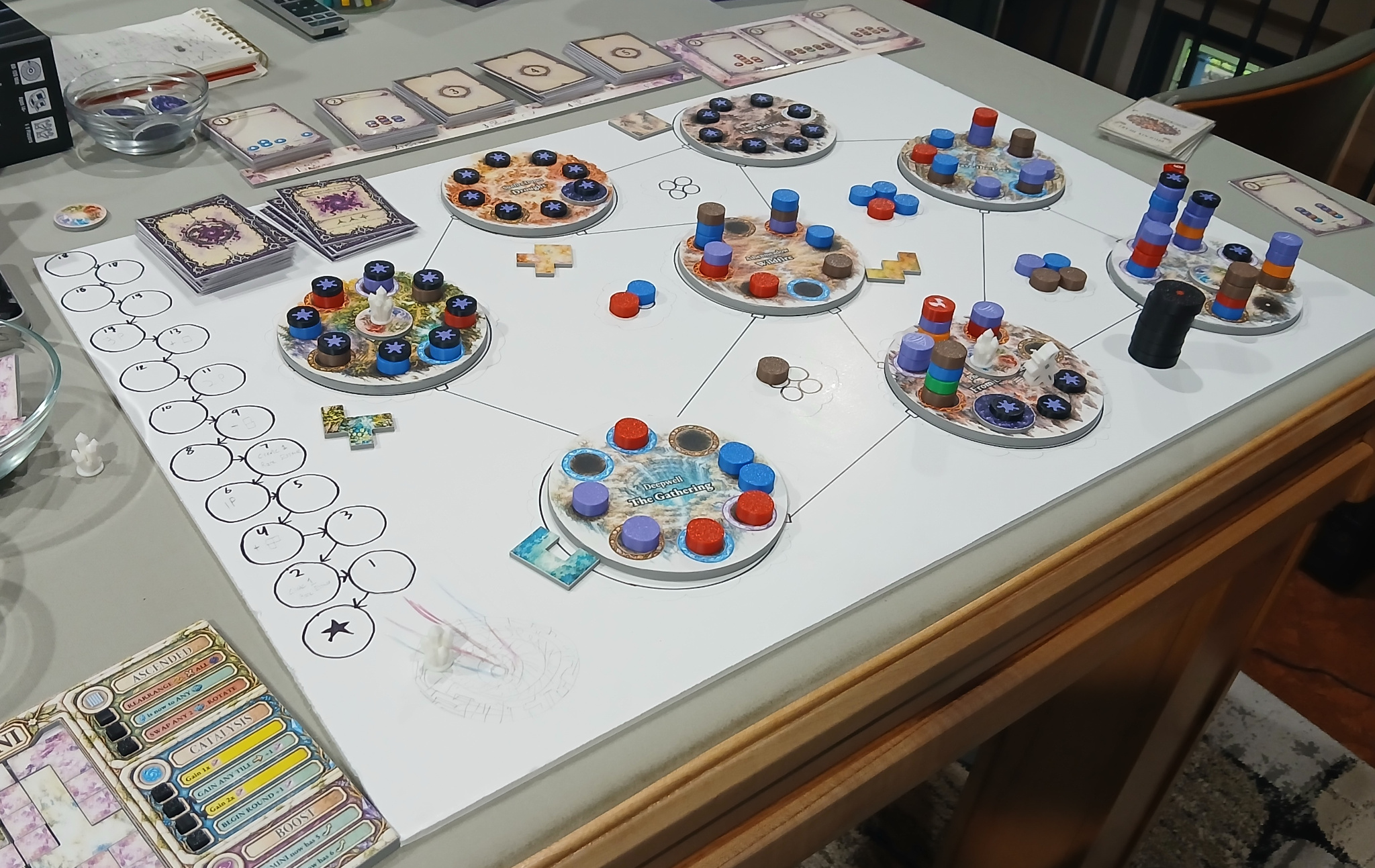
Even in the earliest versions, I was imagining physical pieces, possibly meeples, representing terrain. Once those evolved into stacking discs, the game naturally became three-dimensional.
And that physical aspect eventually started influencing the abilities themselves.
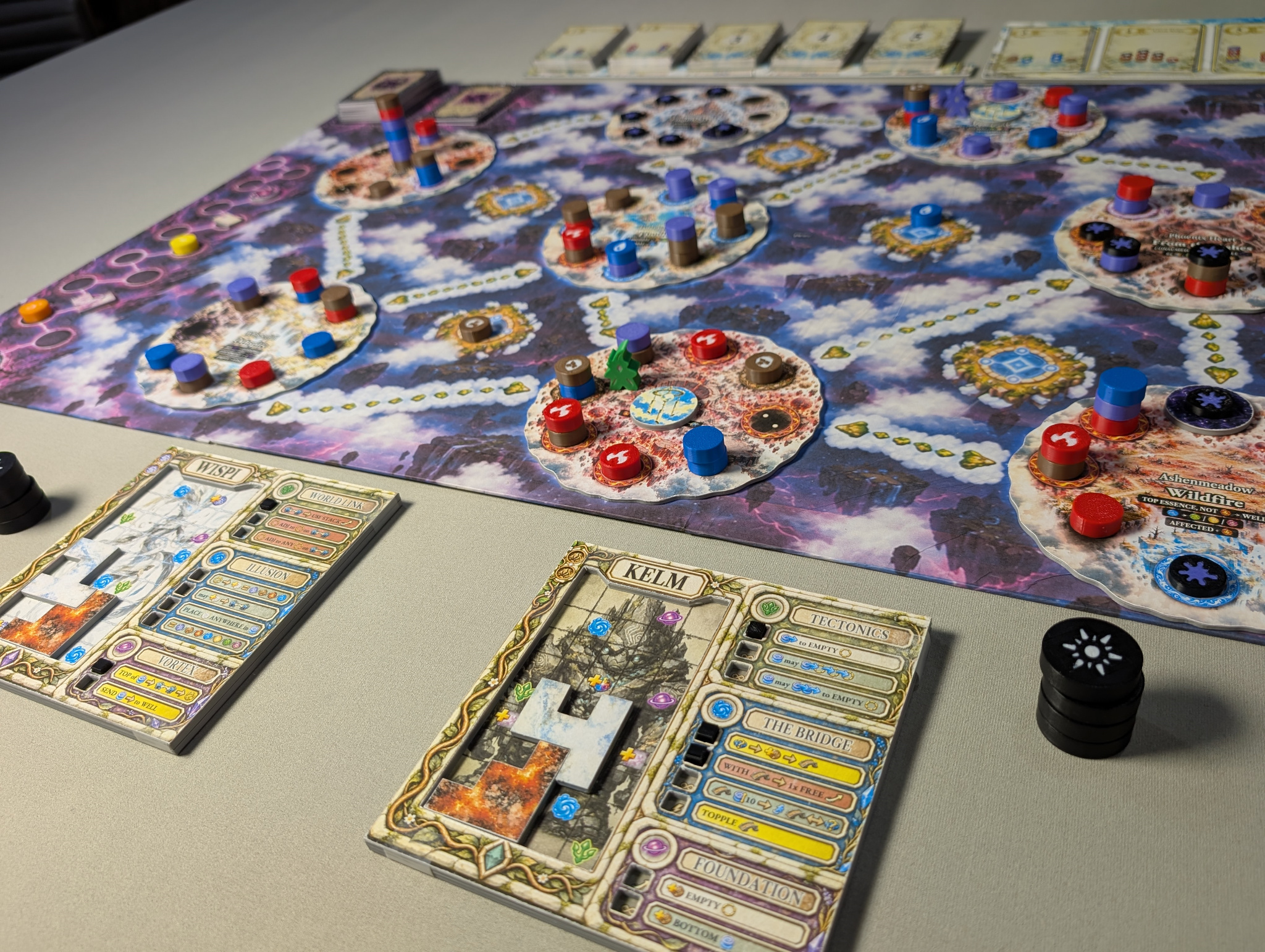
Kelm’s Tower is a great example. Players can build an enormous tower of discs right on the table and then actually topple it over as part of the gameplay.
The three-dimensional nature of OTH isn’t just for appearance. It’s part of how the game works.
Do you remember when you first felt that OTH could become something special?
Absolutely. I remember one particular playtest.
I had the board set up with generic Worlds, and the Oth—still called the Ooze at the time—was steadily closing in. Back then, it simply advanced once every turn. The Oth deck hadn’t been invented yet.
It all came down to completing one final Crystal. Crystals were the early version of what we now call Resonances, and most of them involved just one or two different types of elements.
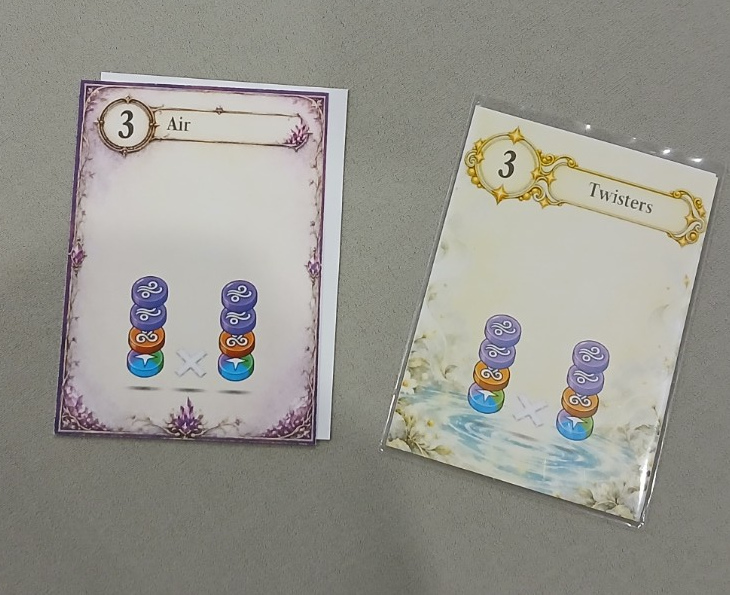
The Crystal I needed was called Twisters.
Funny enough, Twisters is the only Crystal that remained completely unchanged when I converted them into Resonances.
I was just barely able to create the required pattern on the very last turn before losing.
And I remember thinking, “That was pretty awesome.”
What made that victory so memorable?
The desperation.
Things looked hopeless, but I was able to pull off several clever plays involving Spirit, which could float over the Oth.
Finding those moves and managing to complete Twisters at the last possible moment was incredibly satisfying.
It was that feeling of somehow finding a way to win when everything seemed lost.
How different is OTH from the game you played that day?
Most of the fundamentals have stayed surprisingly similar.
The biggest change was introducing the Oth deck. Instead of the threat simply advancing every turn, the deck made its behavior more unpredictable.
That also gave me a convenient way to adjust the game’s difficulty.
Different players have different skill levels, and I wanted them to be able to experience that same feeling of desperation I had during the Twisters playtest.
The Oth deck helps make that possible.
Looking Ahead
OTH has changed considerably since those first experiments with primordial ingredients and terrain discs, but the heart of the game remains much the same: creating Worlds, discovering clever combinations, and finding a way forward when things look hopeless.
In future installments of Inside OTH, we’ll explore the Shapers, the unique puzzles presented by different Worlds, and the design decisions that continue shaping the game.
OTH is currently in development at B Squared Games.
Back to OTH Next interview: Worlds Within Worlds