
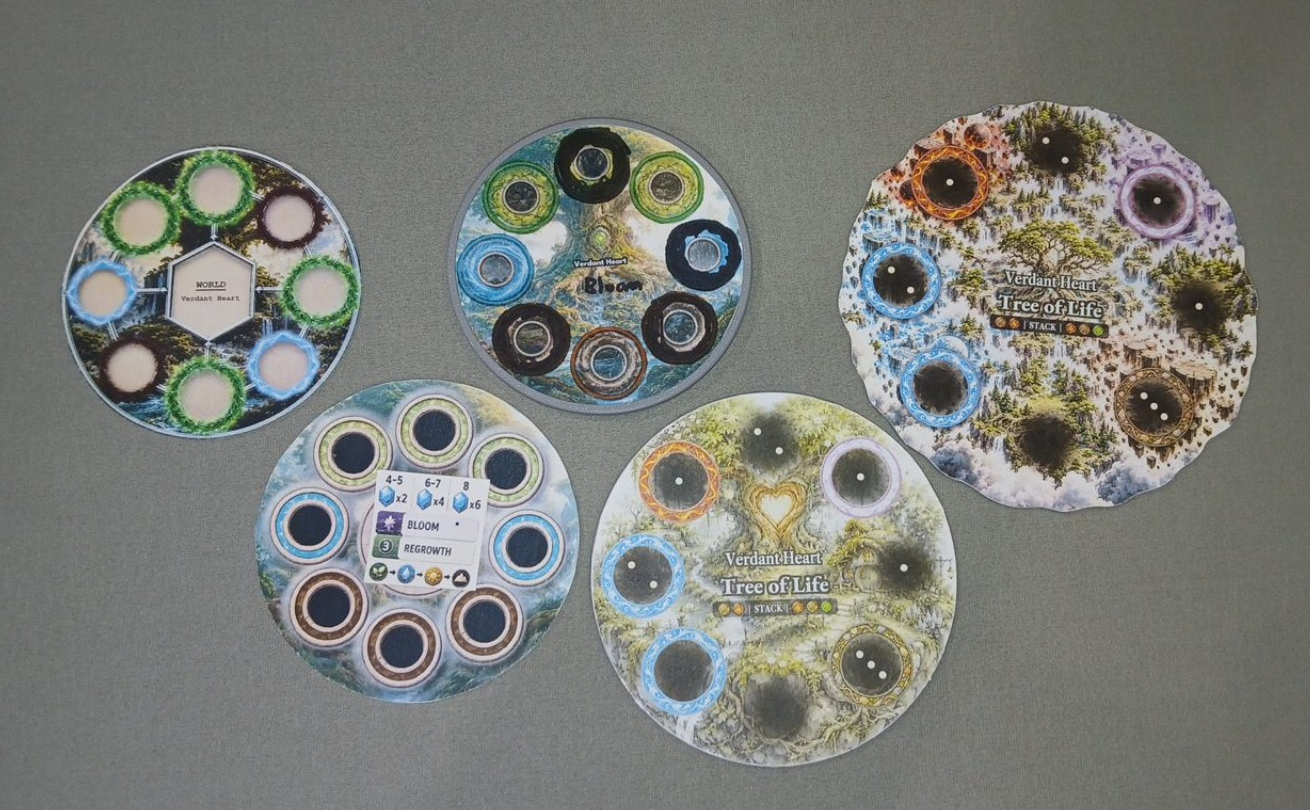
In our second interview, we explore how the Worlds grew from interchangeable locations into individual puzzles—and how their Awaken Effects can change the direction of an entire game.
The Worlds in OTH feel very distinct from one another. Were they always meant to be unique?
Not at first.
Originally, I imagined the Worlds themselves being generic, with a tile in the middle that could be swapped out from game to game. The idea was that the World would stay the same, but its “core” would change.
After playtesting, though, I realized there was too much information that needed to fit on those tiles for the idea to work well. At that time, the Worlds were also only 4 inches in diameter, compared with the 6-inch Worlds the game uses now.
That led me in a different direction. Instead of using interchangeable World Cores, I decided every World would be unique. That change let each World’s artwork, Harmony requirements, and Awaken Effect all fit together as part of a single identity.
When designing a World, what came first?
The first few Worlds were more focused on Elements themselves.
Verdant Heart was the first one. Early on, it required a lot of Life in addition to Earth and Water. Later, I found it worked better if Worlds Awakened using only Basic Essence, so that eventually changed, but the original version shows how element-focused those early designs were.
Once some of the core Worlds were designed, I started exploring more unusual ideas.
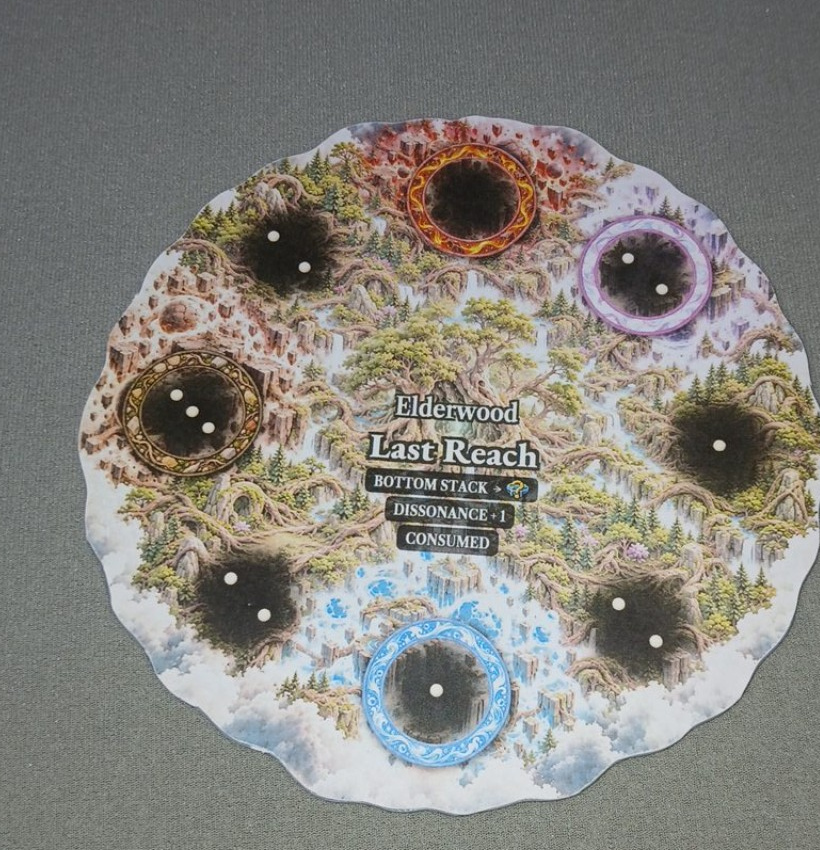
Elderwood came from joking around with the idea that maybe Awakening a World could actually be a bad thing instead of always being beneficial. In Elderwood, the World becomes completely consumed by Oth after it Awakens.
That realization really propelled a lot of World designs afterward.
Why would players ever want to Awaken a World like Elderwood?
That comes down to how victory works.
To win the game, players need to Attune Resonances worth a certain amount of points. Resonances can only be Attuned on Worlds that have already been Awakened, and each World can only hold one Resonance. That means players are going to need some Worlds Awakened even when they would rather avoid doing so.
In Elderwood’s case specifically, it provides a little bit of value toward victory on its own, so players don’t necessarily need to Attune a Resonance there. It also gives each player a polyomino used to upgrade their Shaper, and it allows players to send some of the Essence from that World to other Worlds to help Awaken them or Attune Resonances elsewhere.
So even though the effect looks negative at first glance, Elderwood is really a trade-off.
What’s another World that shows how different Awaken Effects can be?
Phoenix Heart comes to mind immediately.
Normally, when a World Awakens, its effect happens right away. Tidal Basin is a good example: its Flood effect turns the two highest stacks into islands, while the rest of the World is cleared of Oth and Essence and replaced with Water Essence.
Phoenix Heart works very differently.
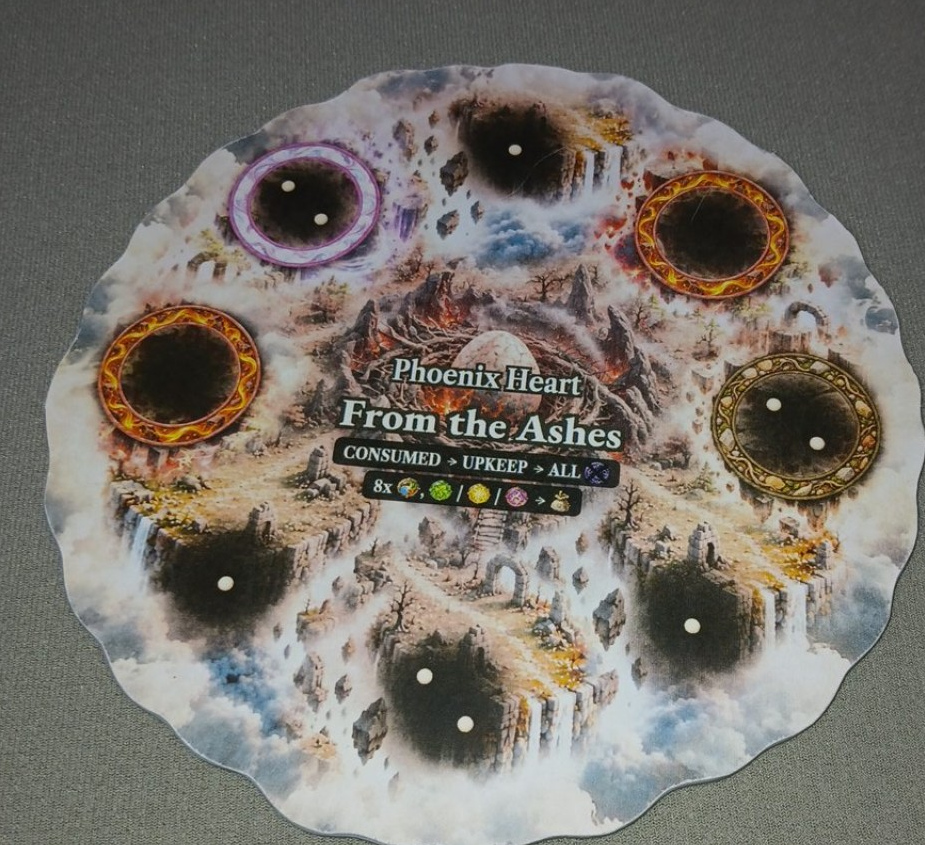
When it Awakens, nothing happens immediately. Instead, once the World has been consumed by Oth during a later upkeep, all of that Oth is removed as the effect From the Ashes triggers, and some new Essence is added to the World. That gives players another chance to Attune a Resonance there.
Players can even choose to pay relatively little attention to Phoenix Heart if they want, though there’s a risk that Oth will scour away the initial Essence on the World before that delayed effect pays off.
How do Harmony requirements fit into a World’s identity?
Sometimes I’m aiming for something that feels thematic.
Skyreach Peak, for example, has a lot of Air Harmonies. That just feels appropriate for the kind of World it is.
Other Worlds use Harmony requirements more mechanically.
In Sanctuary, there are several sites where players deliberately want to leave space empty. That matters because its Awaken Effect, Save the Lost, brings Oth-threatened stacks from connected Worlds into Sanctuary. So part of the puzzle is not just building the right patterns, but leaving enough room for what’s going to happen next.
That’s something I enjoy about designing Worlds in OTH. Sometimes the puzzle is about what players need to build. Other times, it’s about what they need to prepare for.
How important is interaction between Worlds?
It’s been important from the very beginning.
Originally, Awaken Effects were one of the main ways for players to get Rare Essence—Life, Light, and Spirit—into the system, so Worlds were heavily tied to one another. Molten Forge is a good example of that. Its eruption sends the tallest Fire-topped stack to a neighboring World, helping the players somewhere else on the board.
That kind of interaction was a big part of making the Worlds feel connected rather than isolated.
That said, in the earlier design, Worlds were probably too dependent on one another. Over time, I’ve reduced that somewhat by adding other ways to inject Essence into the system. I still want Worlds to work together, but I don’t want the game to feel like it only works if the exact right Worlds happen to be next to each other.
What do different combinations of Worlds add to the game?
A bit of both familiarity and discovery.
Players may recognize certain Worlds and understand what they do, but each game still changes because the Worlds are laid out differently, they begin with different Essence, and Oth starts in different places. At the beginning of the game, two Worlds are selected as Rupture points, and that has a huge effect on which Worlds are immediately threatened and which ones might be abandoned.
So even when players know a World well, the situation around it can make it feel very different from one game to the next.
Is there a World you’re especially proud of?
This is a hard choice, but I’d go with Whisperfall because of how dramatically it changes the game.
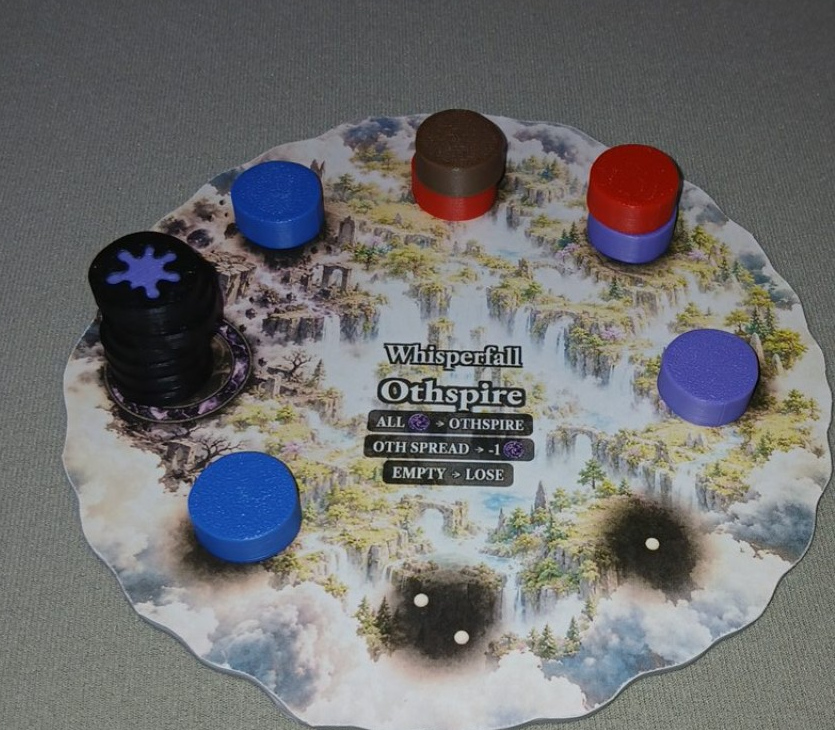
Whisperfall is one of a couple of Worlds that are Awakened by Oth rather than by Essence, although players still need to take the Awaken action, so they can choose whether to trigger it.
When Whisperfall Awakens, players take all of the Oth on that World and stack it onto its single Harmony site. From that point forward, Oth no longer spreads on any of the Worlds. That gives the players some breathing room.
But there’s a catch: every time Oth would have spread, one Oth is removed from that stack instead. Once the last Oth is removed, the players lose.
I like Whisperfall because it shows how a single World in OTH can do more than provide a puzzle or a bonus. It can fundamentally change the shape of the game.
Looking Ahead
The Worlds in OTH began as a practical design problem: how to represent different places and effects without overwhelming players with too much information. Over time, they became one of the most distinctive parts of the game.
Each World now carries its own identity through its artwork, Harmony requirements, and Awaken Effect. Some reward players immediately. Some ask for careful preparation. Some create risk, and others completely reshape the rules of the game.
In the next installment of Inside OTH, we may turn our attention to the Shapers—the characters who interact with these Worlds in dramatically different ways.
OTH is currently in development at B Squared Games.
Back to OTH Previous interview: Where It All Began