
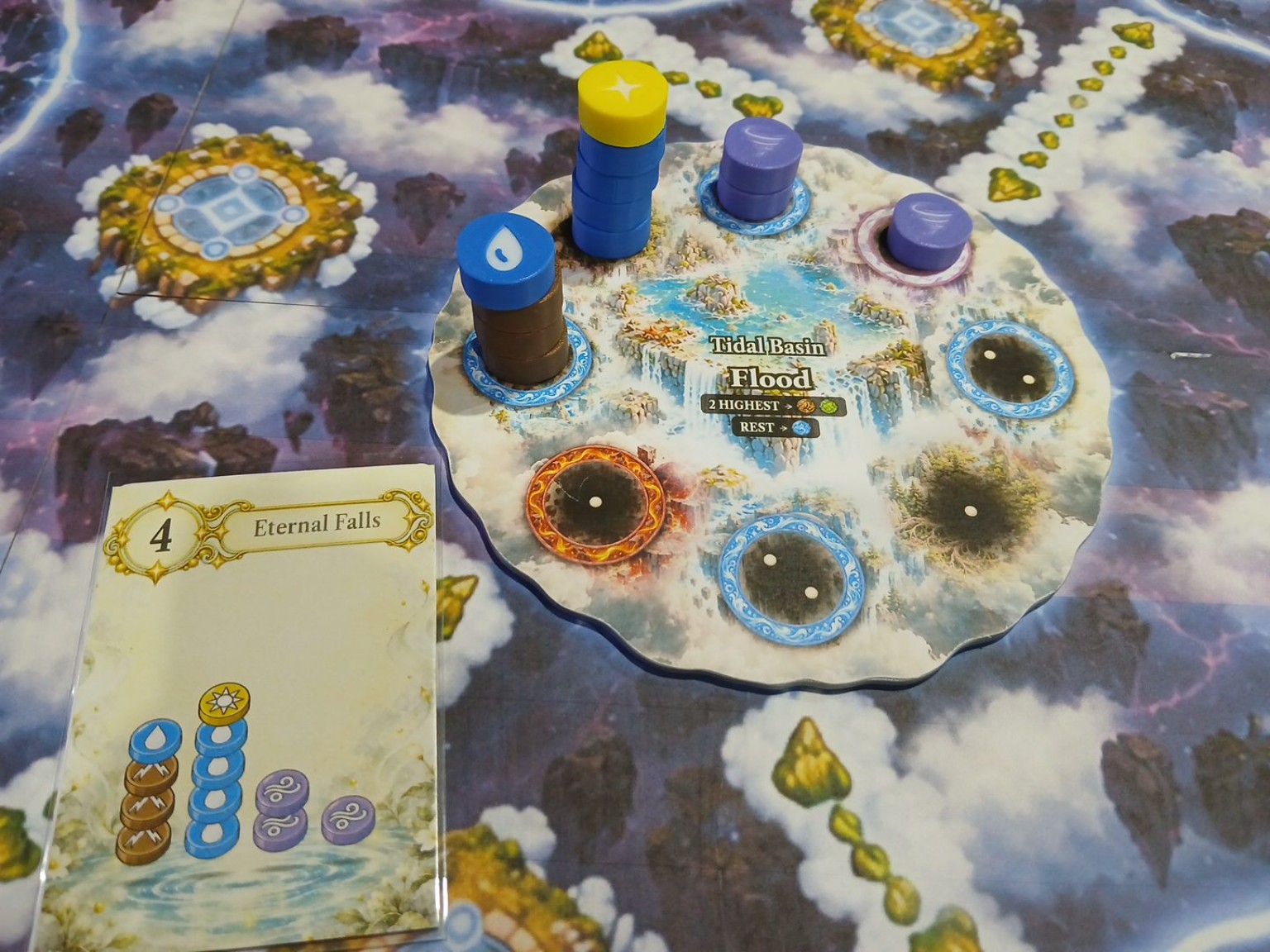
In our second interview, we look at the heart of OTH’s gameplay: arranging Essence, combining actions to solve problems, and reacting when the spreading Oth threatens those plans.
What are players actually trying to accomplish with Essence?
Players are essentially solving puzzles on Worlds.
The first puzzle is relatively straightforward: get the right type of Essence onto the correct sites to Harmonize a World. Once those requirements are met, players can Awaken that World.
But that’s only the first step.
To win, players must Attune Resonances worth a certain number of points. Each Awakened World can have one Resonance Attuned on it.
A Resonance is essentially a specific arrangement of Essence across a World. For instance, one Resonance called Eternal Falls requires players to arrange Essence into the shape of a waterfall.
So players aren’t just collecting the correct resources. They’re physically constructing patterns with them.
How do players manipulate Essence to solve these puzzles?
Players have several different actions available to them.
There’s Flow, which moves the top Essence of a stack to a lower adjacent site. Bury moves the top Essence to the bottom of its stack. Swap exchanges Essence, Merge combines stacks, and Cascade disperses a stack.
Each action has its own uses, and players can combine them in different ways to solve the same puzzle.
That’s something I enjoy about the system. There isn’t necessarily one correct sequence of moves. Players can look at the same situation and come up with completely different ways to reach their goal.
And to make things more interesting, certain types of Essence actually change what players can do with those actions.
Can you give an example of how an Essence type changes the puzzle?
Earth is a good example.
Earth Essence is solid. It doesn’t move as easily as the other Essence types, so players can never use the Flow action with Earth.
That creates some interesting situations.
Imagine you have a stack of three Essence, and the adjacent site requires Earth to Harmonize it.
With most other Essence types, you could simply Flow the correct disc onto that site. But Earth can’t Flow, so you have to find another solution.
One possibility is using Bury to position Earth at the top of your stack so you can move it using Merge.
Alternatively, you could use Bury to get Earth to the bottom of the stack and then Cascade the stack to distribute its Essence.
Both approaches can accomplish something that initially appears impossible.
I like that players have to think about what the actions can accomplish together, rather than treating each action as an isolated move.
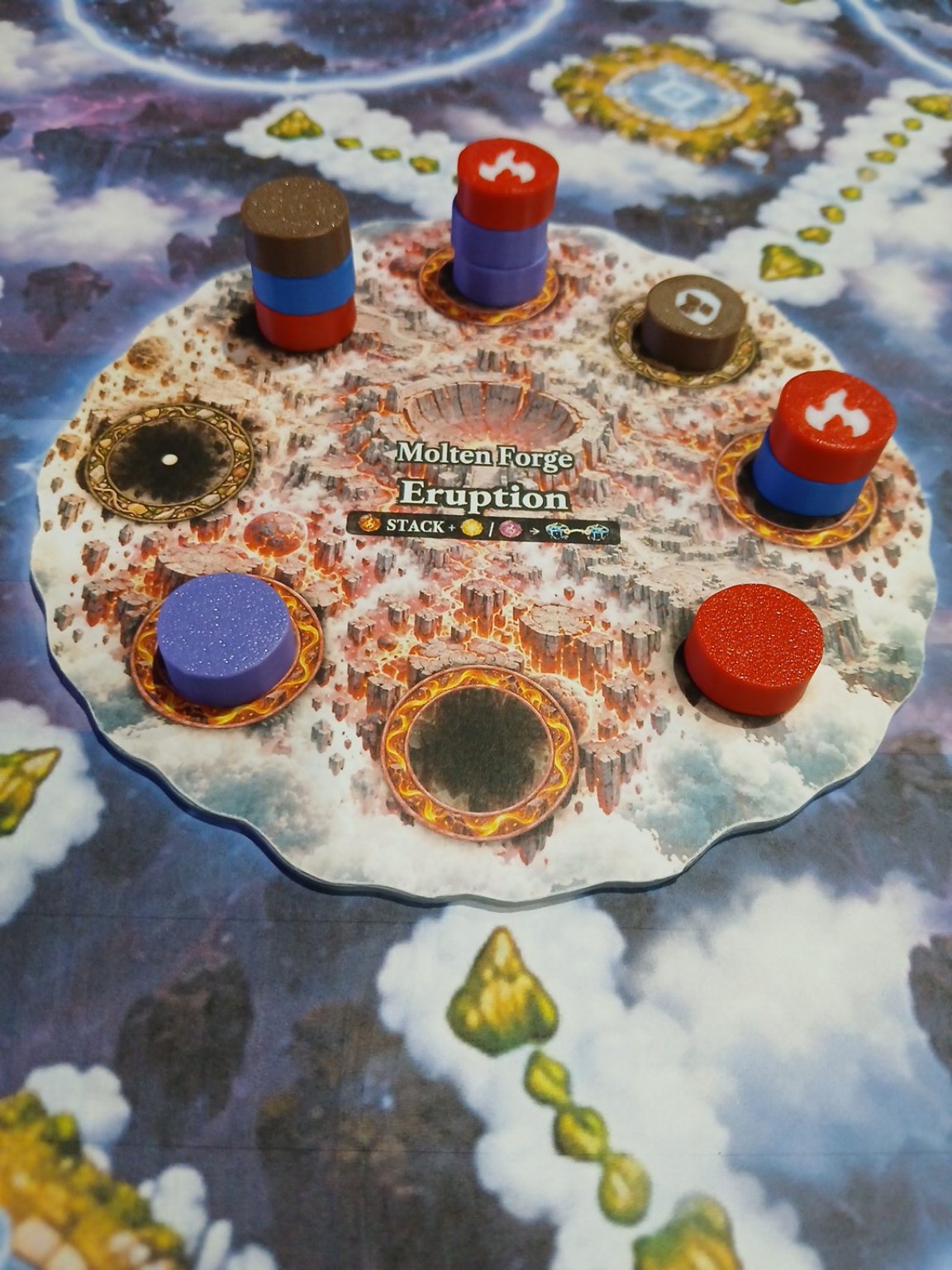
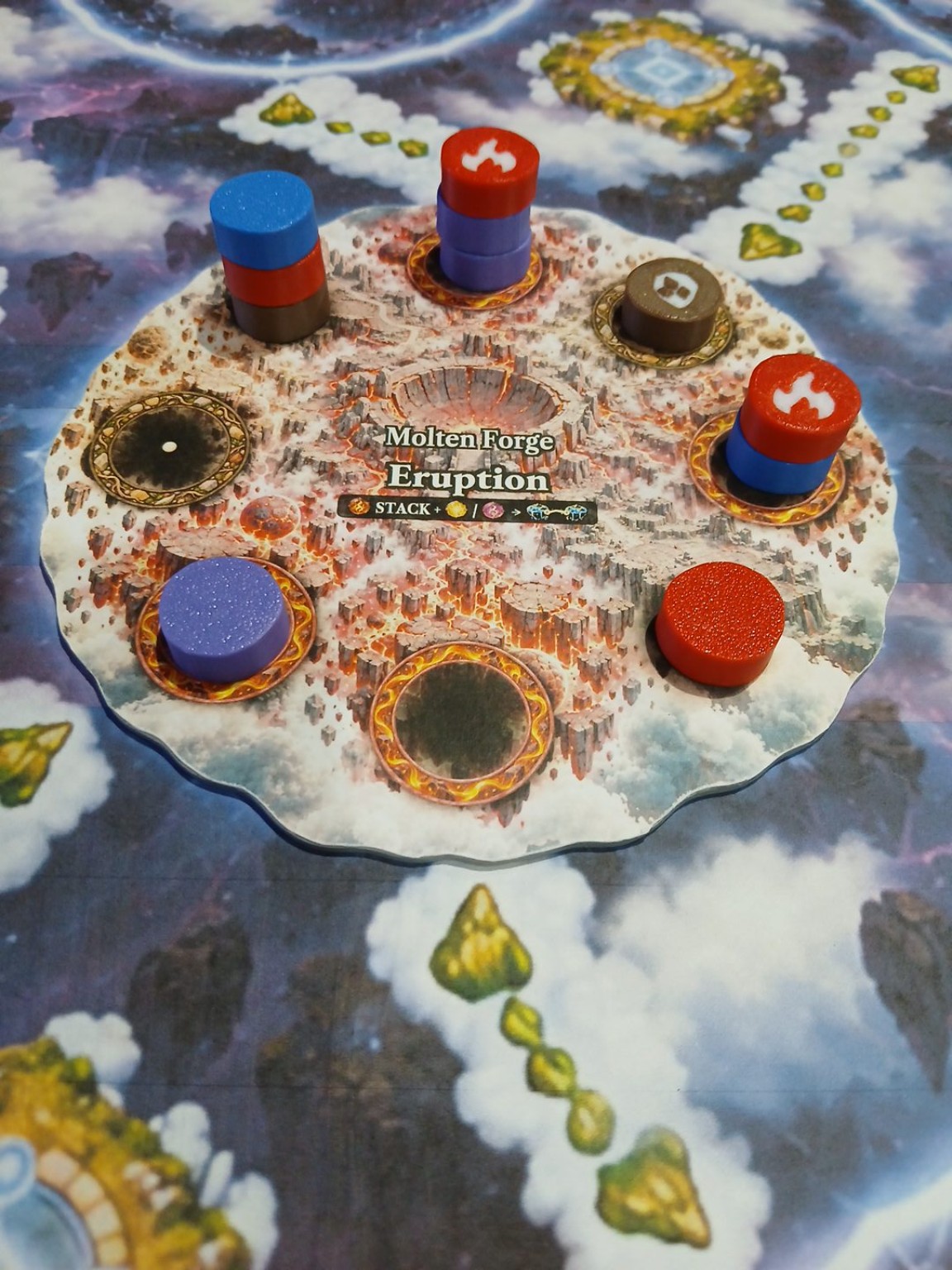
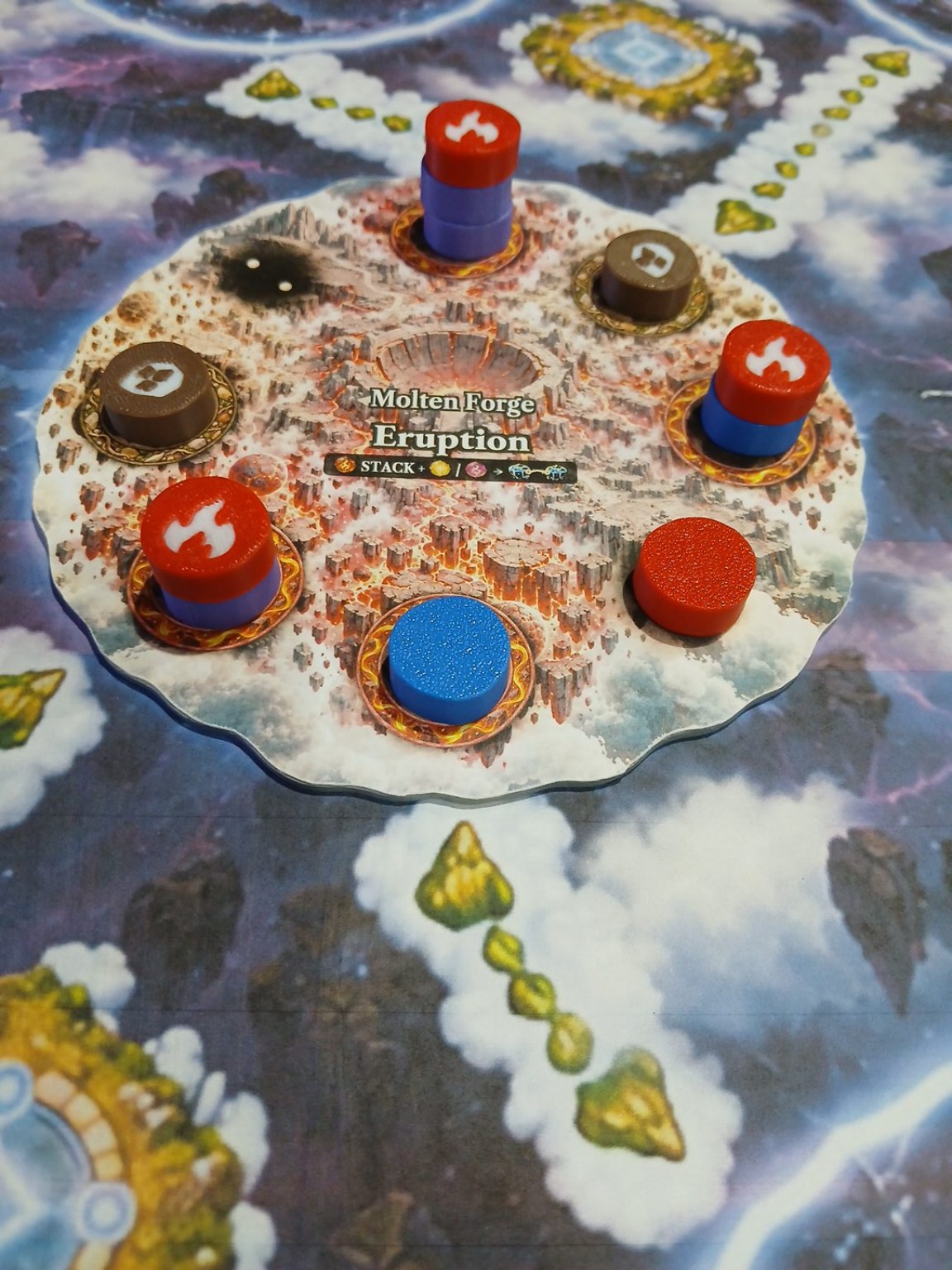
One puzzle, multiple approaches. These are the original, unaltered photographs of a Bury-then-Cascade sequence.
How does Oth interfere with these puzzles?
In a couple of ways.
First, Oth can occupy a site that players need for Harmony. That makes Harmonizing the World impossible until they deal with it, such as by using Water Essence to Cleanse the Oth.
Oth can also scour away Essence, removing pieces that players were counting on to Awaken a World or Attune a Resonance.
You might spend several actions carefully arranging Essence, only to have Oth interfere and force you to rethink your plans.
But there’s another interesting wrinkle: some Resonances actually require Oth itself.
Those are especially time-sensitive. Players need to work with something that’s actively threatening them. If they mistime their actions, Oth could scour away the very pattern they were trying to complete.
So Oth isn’t always just an obstacle to remove. Sometimes it’s part of the puzzle.
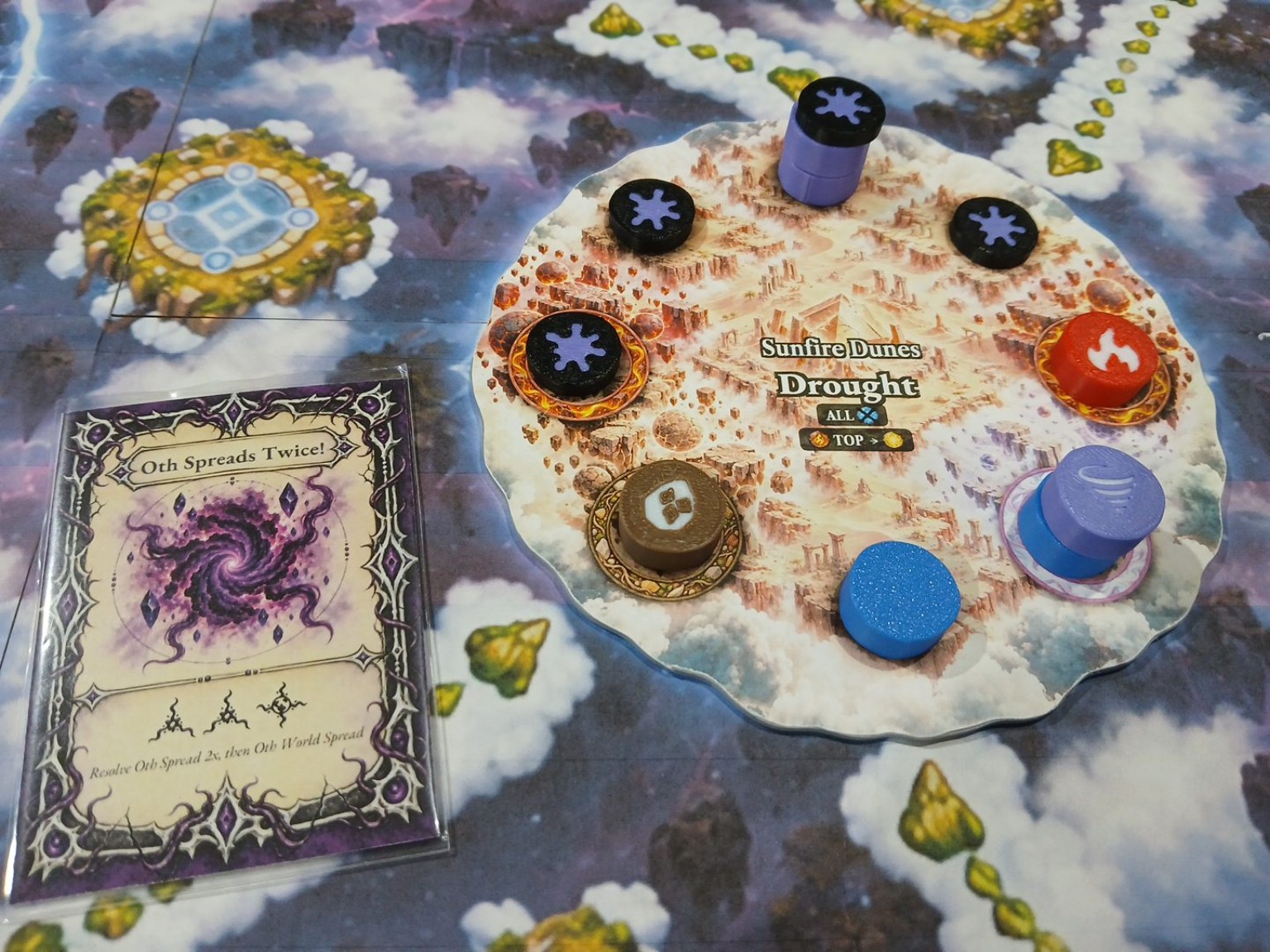
How does the Oth deck change the experience?
The biggest thing is that you can never be 100% certain what Oth will do.
Originally, Oth simply spread once every turn. That made it fairly predictable.
With the Oth deck, there’s always a possibility that Oth will spread farther than players anticipate. It can wreck their plans if they haven’t taken precautions.
For example, players might keep Water nearby in case they need to Cleanse Oth, or avoid leaving Fire exposed at the top of a stack, because Oth can continue spreading from Fire-topped stacks.
It’s about trying to anticipate what could happen without knowing exactly what’s coming.
But that unpredictability works in the players’ favor sometimes, too.
When things are looking desperate, players might be hoping to draw an All Quiet or Resupply card, giving them a round without Oth spreading.
That can be just enough time to recover, complete a critical Harmony, or finish a Resonance before everything falls apart.
I think that uncertainty is a big part of what makes the game exciting. You’re trying to solve these puzzles while constantly weighing how much risk you’re willing to take.
Looking Ahead
At its heart, OTH is a game about finding clever solutions.
The Essence actions are relatively straightforward individually, but combining them with different Essence properties, World requirements, and the unpredictable behavior of Oth creates a much larger puzzle.
Sometimes players can carefully plan their moves. Other times, they’ll need to improvise when Oth threatens to undo everything they’ve accomplished.
In our next installment of Inside OTH, we’ll explore Worlds Within Worlds—how the individual Worlds evolved, why each has its own identity, and how their Awaken Effects can dramatically change the game.
OTH is currently in development at B Squared Games.
Back to OTH Previous: Where It All Began Next: Worlds Within Worlds